
It is important for parents to speak directly with a child care specialist to help determine specific child care needs of the family. Depending on the family’s size and income, a yearly fee of $0 - $30 may be charged for the referral service. The family will be given a list of child care providers and options tailored for them, as well as other information and resources to help them as they choose a child care provider.
WCCCC provides parents with a list of referrals only and can not endorse or recommend one child care provider over another.
Referral lines are open from 8:30 a.m. to 4:00 p.m. Monday through Friday. Call (217)222-2550 or 1-800-782-7318.
*Licensing Regulations: A license means that the provider has met the State of Illinois’ minimum standards for care. The licensing agency in Illinois is the Department of Children and Family Services.
CHILD CARE CENTERS
Child care centers provide full or part-time child care in a group setting with planned activities. Most often licensed by the state, they must meet minimal health, safety and staffing requirements.
Children are grouped together by age, with activities planned especially for that age level. Each classroom has materials and activities which support a planned curriculum.
There is usually a range of experience and education among the staff. All staff who have contact with the children are subject to a background check for criminal activity. Centers provide substitutes during staff absences or vacations.
FAMILY CHILD CARE HOMES
Family child care is provided for children in the home of the caregiver. Usually, family child care providers are parents themselves. In Illinois, family child care providers who care for more than three children, including their own, are required to be licensed by the Department of Children and Family Services (DCFS).
Family child care offers a blending of ages. Each child has the opportunity to relate to a few other children of different ages- some younger and some older.
A family child care provider may often times be in your neighborhood and may be able to make flexible arrangements. A few providers are available to care for children whose parents work at night or on weekends when centers are not usually open.
PRESCHOOLS
Preschools (or nursery schools) offer group programs for primarily 3 to 5 year old children for a part of the day on specified days of the week. Most follow the school calendar and do not operate during school holidays, vacations, snow days or summer months.
Preschools can be licensed by DCFS under the same regulations as day care centers.
LICENSE EXEMPT
If the family child care provider cares for 3 or fewer children (including their own), or the children from one family, the provider is not required to be licensed. A license exempt family child care provider must be registered with West Central Child Care Connection in order to be referred by the organization. Other license exempt situations may include: in-home care, relative care, or some church and/or educational sponsored child care programs.
SCHOOL-AGE PROGRAMS
School-age programs offer child care before and after school, and for holidays, snowdays, and summer vacation. The families can include child care centers, elementary schools, community centers, family child care homes, parks and playgrounds.
Finding convenient, affordable, quality child care may take a lot of time.
If at all possible, plan ahead. If you suddenly discover that you will need child care next week, however, don’t panic. Try to visit a few providers and compare what you like and don’t like about them. If you can, make temporary arrangements until you can find permanent care, then you won’t feel rushed to make a decision. Choosing child care in hurry or deciding on someone you feel uneasy about, may result in a situation that won’t work and you’ll have to start again. Perhaps you could ask a relative or neighbor if she or he would be willing to help you out or contact a local college to see about a student baby-sitter. Trust your instincts.
Child care in many communities is scarce. Waiting lists exist at many day care centers, especially if they take infants and toddlers. Family day care is hard to locate because few providers need to advertise and market their services. Some state and federal agencies sponsor financial assistance for child care but these programs are limited and often have long waiting lists.
You may have to expand your search by considering a different type of care, a different location or higher fees. Give yourself at least four to six weeks to arrange care. Try to plan for your child to be in the same care for a year or two, but your first choice in child care does not have to last forever. What may be a fine situation for an infant may not meet the needs of your child at age 2.
Consider also what you will do when your child is sick and when your provider cannot take your child. Planning ahead for these situations will help prevent a crisis from occurring.
MAKING CONTACTS
You can establish your initial contact by telephone. Remember to be considerate about the time you call; child care providers are busy people and may not have time for long conversations with you during working hours. Ask if it is a convenient moment to answer a few questions.
Have your questions prepared for the things you want to know about. Points to discuss would include openings, hours, policies, start date and cost. Add to this the other things that are important to you.
If you feel comfortable with the provider and would like additional information, arrange for a visit.
THE VISIT
If at all possible, arrange to visit the program or provider during operational hours. This will give you the opportunity to see what the children do, how the caregiver responds to them, and how your child and the caregiver react. You should observe and find out about the following:
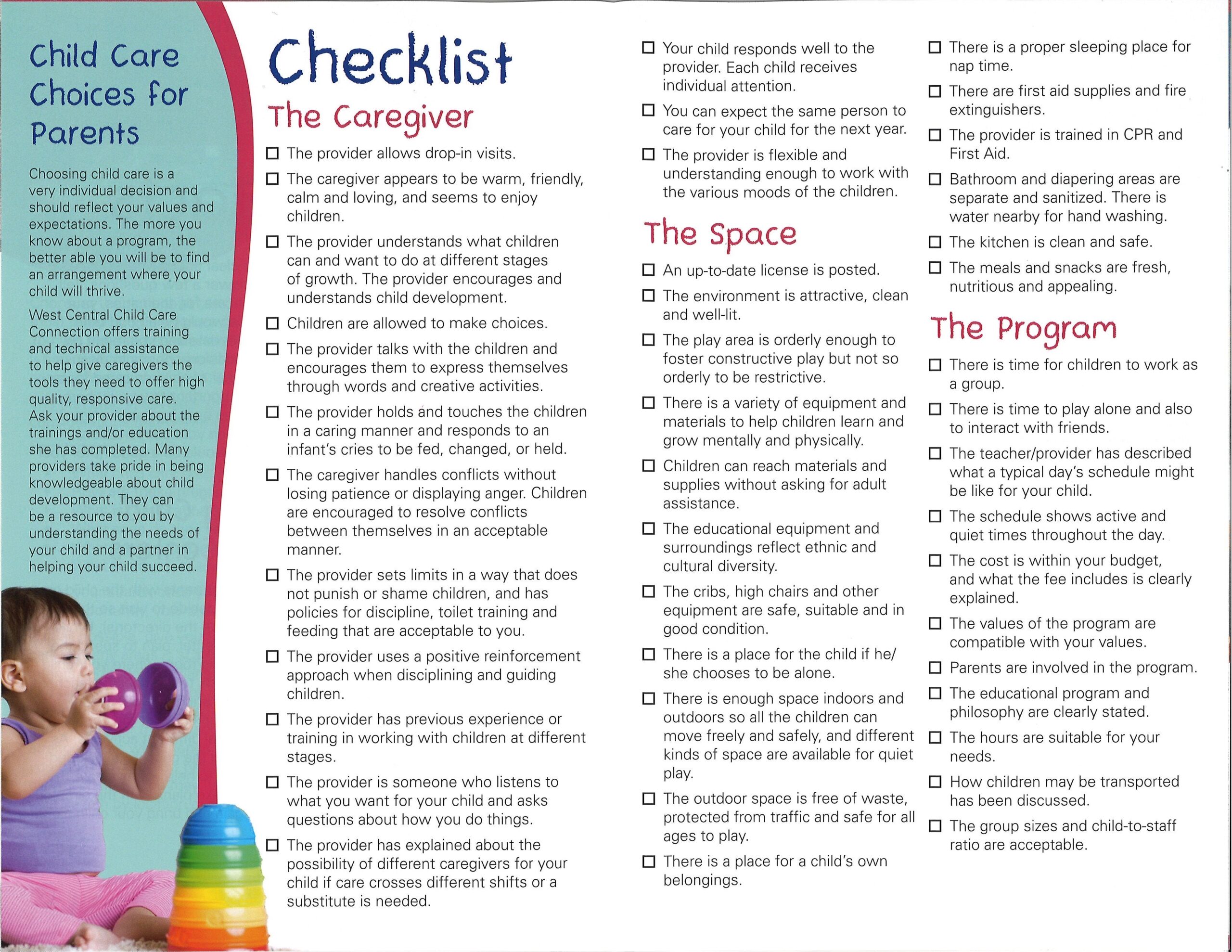
Not every child care situation will be right for you. Trying to evaluate or classify all the information can be overwhelming. A checklist has been included to help you sort through the information and assist you in selecting the child care most suitable for you.
After your visit, feel free to call back at another time to ask more questions and/or discuss how the provider may feel about accepting your child in the program. A second visit without your child will allow you time to discuss any specific concerns or arrangements regarding your child’s care.
THE CAREGIVER
THE SPACE
THE PROGRAM
CHECK REFERENCES
Calling references is an important way to get more information. Ask for names of two or four parents who are using or have used the provider in the past.
MAKING YOUR DECISION: TRUST YOURSELF
After considering all the information you have collected, you are ready to make a decision. You have a right to be particular. This special place for your child should leave you feeling at ease with the provider and the other children. If you feel hesitant about a situation, ask more questions or continue to look until you are confident that your decision will result in good care for your child. You know your child best, so let your parenting instincts be your best guide.
DOES THE PROGRAM FIT?
You may find that despite careful research and observation, the program you
choose is not a good fit with your child. It may be hard to admit there are
problems and that you’ll need to reopen your search, but it is essential
that both you and your child are happy with the program.
WHAT ABOUT SPECIAL NEEDS?
The Americans with Disabilities Act assures that children with special needs will be considered for admission into child care programs. Your decision will be based on what is available in the community, how specialized your child’s care may be, and what you think will work best for your child and you.
The introductory period in any child care arrangement is a big change for both you and your child. It can be a very emotional experience for both, but with some advance planning the transition can be easier. Time spent helping your child through a gentle separation can prevent problems later, and can get all of you off to a good start. Some ways to help a smooth transition are:
Quality child care for your child depends on both you
and your caregiver. Share information with the caregiver about your child’s
needs, interests, problems, personality- anything that will help the caregiver
provide the best care for your child.
If the caregiver has concerns about your child, listen without being defensive
and be willing to talk it over.
Remember, you and the caregiver are not competing for your child’s affection. No one can replace you. But the caregiver is an important person in your child’s life. Both you and the caregiver want the same thing: to do all you can to help your child grow to be a happy, caring, whole human being.
10 Things Your Child Care Provider Should Expect From You


![]() |
|
![]() |
|
![]() |
|
![]() |
|
![]() |
|
![]() |